
Last Updated on November 20, 2026 by babyfinds
Disclosure: As an Amazon Associate I earn from qualifying purchases. Links in this guide go to Amazon, where details and availability can change.
The best first toys match the skill your baby is practising right now: looking and grabbing at 0–6 months, banging and stacking at 7–12 months, pushing and pretending after 12 months. All fifteen toys on our Baby Toys Essentials list are grouped by the AAP’s own age bands below, with the five we reach for most explained in detail.
All fifteen toys from our Baby Toys Essentials list, sorted by the stage they suit — tummy time, sitting and stacking, then first steps and first words.
Toy aisles are loud, bright and full of promises. Babies are simpler: at each stage they want one new skill to practice, over and over. Match the toy to the skill and even a small collection gets played with daily. How play changes as your baby grows is the story in Toys by Stage: What Babies Actually Play With, 0–24 Months.
Here are all fifteen toys from our Baby Toys Essentials list, grouped by the AAP’s own age bands — birth to 6 months, 7 to 12 months, and 1 to 2 years — with the five we reach for most explained in detail.
How we chose these picks
How we choose: every pick on this list comes from our own Amazon Idea Lists, judged against the same fixed criteria for its category and checked against AAP, CPSC or NHS guidance where it applies. Where we have used a product in our own home, we say so in the text; where we have not, we say what the product is for and what to watch for instead of pretending otherwise.
- Matched to the AAP’s developmental stages, not just the age printed on a box
- Bigger than a baby’s mouth — the AAP’s simplest choking-safety test
- Open-ended: toys that do more than one thing get played with longer
- No small parts, loose magnets or button batteries within a baby’s reach
- Rewards the baby’s own effort — banging, stacking, pushing — not just watching
Prices and availability change — check Amazon for the current price.
The picks, one by one
Fisher-Price Glow and Grow Kick & Play Piano Gym — 0–6 months · Best for tummy time
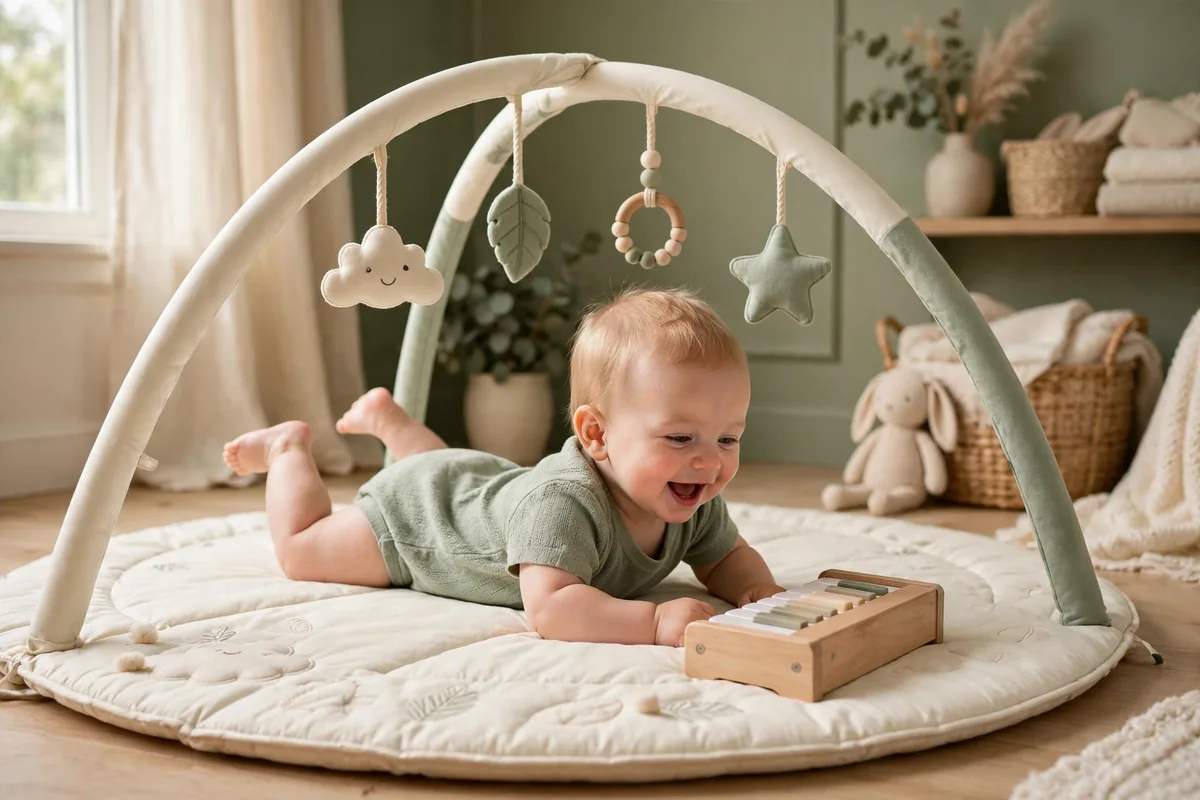
Why we like it: The anchor of the 0–6 month stage: baby kicks, the piano answers, and tummy time turns into a game instead of a protest. The mat and arches give looking, listening and grabbing practice in one spot.
Keep in mind: Take hanging toys down once your baby pushes up on hands and knees or reaches 5 months, per AAP guidance — the gym’s mat and piano still earn their keep after that.
Lamaze Freddie the Firefly — 0–6 months · Best clip-on companion
Why we like it: High-contrast wings, crinkle sounds and a clip that attaches to the stroller or car seat — Freddie is the toy that has survived all three of our babies. Perfect first ‘look, listen and grab’ practice.
Keep in mind: Clip-ons are for supervised awake time on the go, not for the crib — the sleep space stays beautifully boring, with nothing in it but baby and a fitted sheet.
VTech Busy Learners Activity Cube — 7–12 months · Best sitter-stage toy
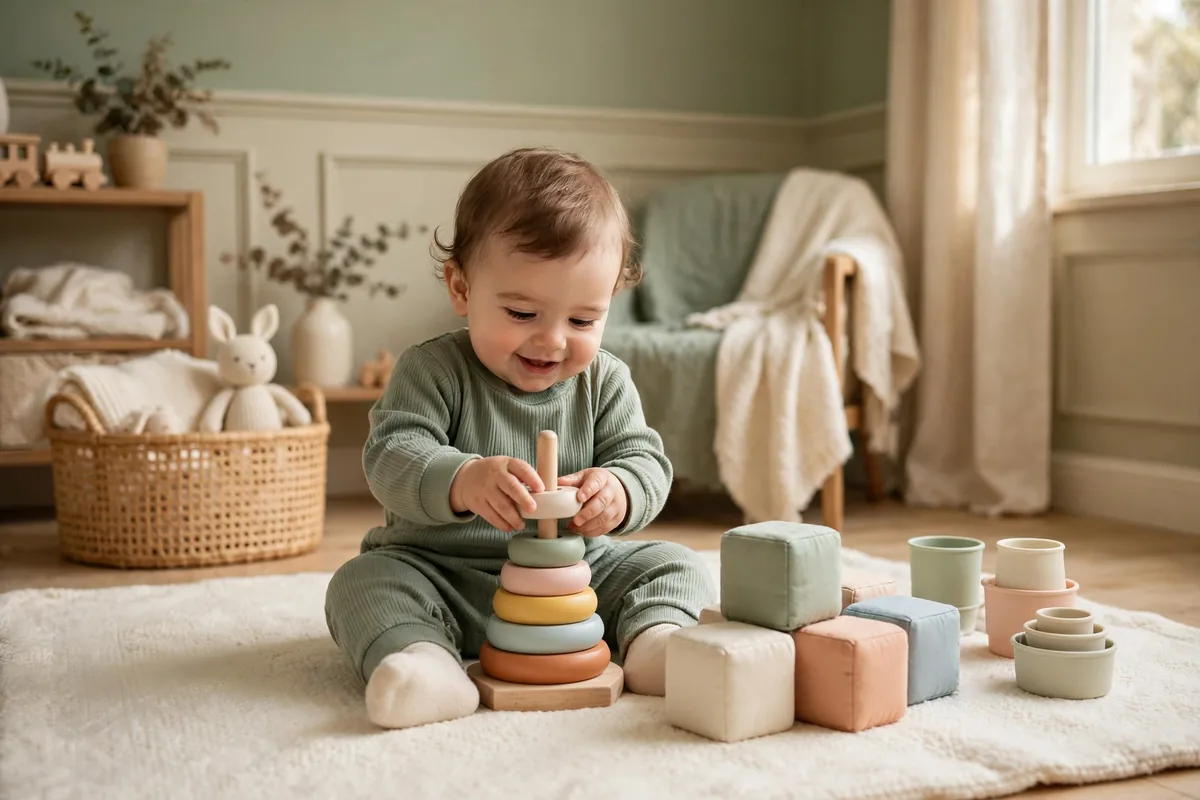
Why we like it: Five sides of bang, spin, slide and press for the stage when babies become little scientists who must test everything. It holds attention through the sitting months better than almost anything we own.
Keep in mind: It has sounds and lights, so treat it as one option among quieter toys — blocks, cups and books — rather than the whole toy box. You are still your baby’s favorite toy.
LeapFrog 100 Words & 100 Animals Book Set — 12 months+ · Best first-words pick
Why we like it: Sturdy pages a toddler can turn alone, with words and animals to name together. It builds the point-and-say game that fills the second year, and it survives being read at breakfast, daily.
Keep in mind: Touch-and-talk books support language best when you talk back — name, repeat, and add one word of your own. The AAP advises no screen time under age 2, a book like this is the richer swap.
Skip Hop 4-in-1 Sit-to-Stand Walker — 12 months+ · Best for first steps
Why we like it: It grows through four stages, from seated play to a steady push-along for new walkers, with lights and sounds that reward each wobbly lap of the living room. Sturdy enough that our youngest inherited it in fine shape.
Keep in mind: Push toys belong on flat floors away from stairs — keep the gate closed — and walkers with wheels are for supervised play, never a parking spot for baby.
Side-by-side comparison
| Stage | Toys from the list | What baby is practicing | Watch for |
|---|---|---|---|
| 0–6 months | Piano Gym · Freddie the Firefly · Winkel Rattle · Oball · Flip Fish | Looking, listening, grabbing, tummy time | Remove hanging toys at 5 months / pushing up |
| 7–12 months | Activity Cube · Rock-a-Stack · Baby’s First Blocks · B. toys Squeeze Blocks · Moonkie Stacking Circles · Peek-A-Boo Forest Book · Baby Einstein Gym | Banging, stacking, filling & emptying | Everything goes in the mouth — size matters |
| 12 months+ | Skip Hop Walker · LeapFrog Book Set · VTech Dump Truck | Pushing, pulling, pretend, first words | Stairs gated; no long strings on pull toys |
How to choose at any age
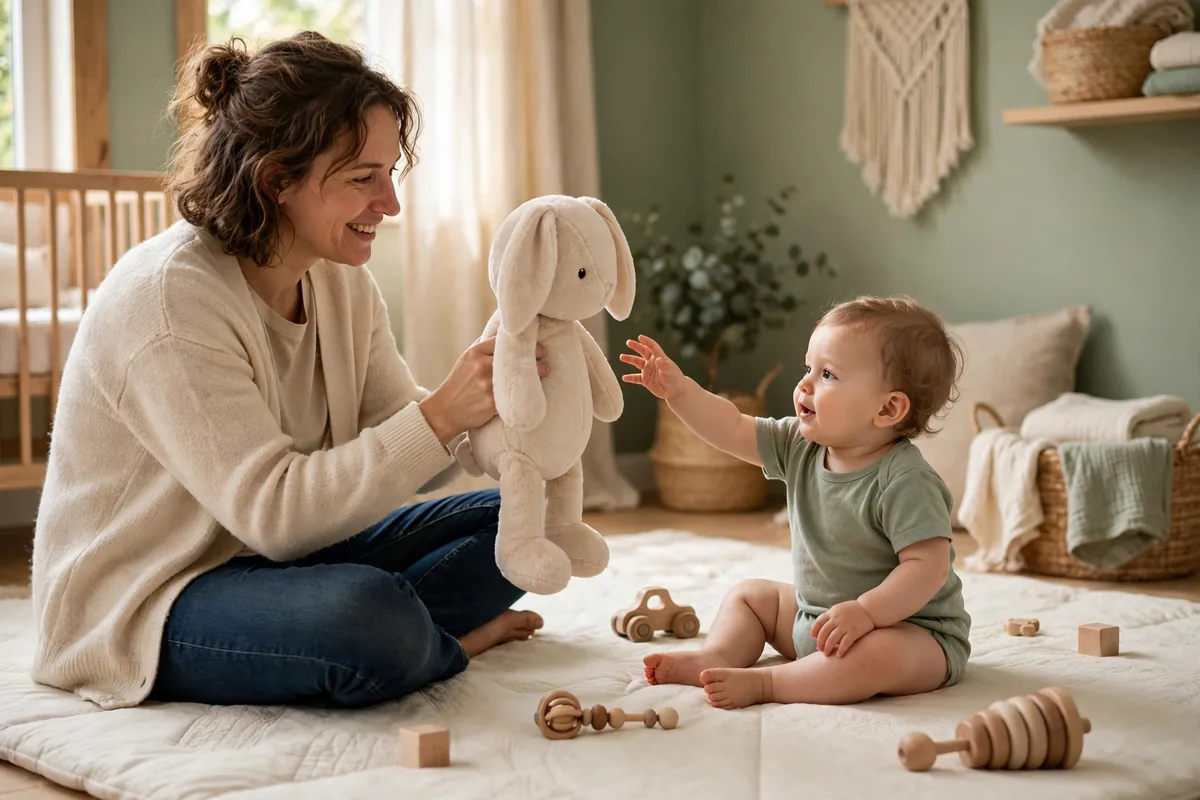
Think BIG: whatever the stage, choose toys and parts larger than your baby’s mouth, read the age label, and keep older children’s small-part toys well out of reach. For the full room-by-room safety order, see Babyproofing Your Home: Where to Start, in the Right Order.
Rotate, don’t accumulate. A few toys out at a time — swapped weekly from a cupboard — holds a baby’s interest far better than a mountain of everything. Store the rotation in one place with Nursery Storage Ideas: Baskets, an Over-Door Organizer & Scalloped Shelves.
Skip the risky extras: button batteries and high-powered magnets can cause serious injury if swallowed, and screens are not toys for under-2s. Your face, your voice and floor time together do more for development than any flashing box.
Parents also ask
Q: What toys are right for a 4-month-old?
A: At 4 months it is all about looking, listening and grabbing: easy-to-hold rattles, soft squeeze balls, an unbreakable mirror, and a play gym for tummy time — the Piano Gym and Freddie the Firefly from our list are the two we start with.
Q: How many toys does a baby need?
A: Fewer than the ads suggest. Three to five well-matched toys per stage, rotated weekly, is plenty. Babies learn by repetition — the same stacking cups, a hundred different ways.
Q: Are electronic toys bad for babies?
A: Not automatically, but they should not crowd out simple toys and face-to-face play. The AAP’s guidance: avoid screen time under age 2, watch for button batteries and magnets, and remember that toys prompting you to talk, sing and respond teach the most.
About the author
Hi, I’m Sarah — a mom of three. I share the baby essentials that actually helped us, so other moms can find what they need — faster, and with less guesswork. Every pick on BabyFinds comes from our own lists, and every care tip is checked against AAP, CPSC or NHS guidance.